5405298
9780553804478
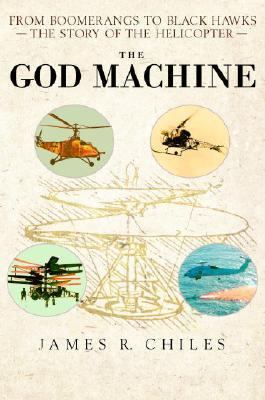
God Machine From Boomerangs to Black Hawks the Story of the Helicopter
by Chiles, James R.
About this item
- Condition: Good
- Provider: BookCellar Contact
- Provider Rating: 92%
- Ships From: Nashua, NH
- Shipping: Standard, Expedited
- Comments: Some wear, but still a good reading copy. A portion of your purchase of this book will be donated to non-profit organizations.Over 1,000,000 satisfied customers since 1997! Choose expedited shipping (if available) for much faster delivery. Delivery confirmation on all US orders.

Product details
- ISBN-13: 9780553804478
- ISBN: 0553804472
- Publication Date: 2007
- Publisher: Random House Publishing Group
AUTHOR
SUMMARY
Chapter One Preflight Of all birds, winged mammals, and insects, very few have mastered the skill of pausing in midair and going backward as well as forward, so anything capable of such flight is, ipso facto, a rare beast. The ruby-throated hummingbird, which can hover with sewing-machine-like precision and also fly more than 500 miles across the Gulf of Mexico without a rest, is one such improbability. Helicopters are another unlikelihood. Explaining how the parts work together to do the unlikely is best approached by treating the helicopter as terra incognita, exploring it from the headland of its cabin to the archipelago of its tail boom. This particular helicopter is white, and composed mostly of high-strength steel and aluminum. It is thirty-one feet long and seats two people, typically a wary instructor on the left and a trainee on the right, but it is also suitable for aerial photography and other daily errands. Anyone renting a Schweizer 300 CBi for weekend travel will be traveling lightly, because there is no trunk for baggage. I required a formal introduction to the Schweizer, because I would be flying one. The instructor I secured from Hummingbird Aviation, John Lancaster, had been a professional skiing instructor for twenty years in Vail, Colorado. Skiing injuries and a love of flight prompted him to seek out a new, and statistically safer, profession. He learned to fly helicopters in Florida at the world's largest privately run helicopter school1 and came to Minnesota to share his knowledge. Typical students were those planning to fly for police departments, tourist outfits, or offshore oil companies. He favored shorts and sport shirts and, before getting down to business, displayed the cheery demeanor of a camp counselor. But he also had nearly a thousand hours of helicopter time and we were both mindful that I was not here to interview him; he was now my instructor. As when dealing with any rookie, his first job was to explain important parts of the ship. Lancaster began my first lesson in the flight-school office by picking up a black-and-white toy police helicopter from a shelf and explaining basic principles of flight. Then he sold me a set of pilot books out of a glass showcase that looked to have been bought from a going-out-of-business sale at a jewelry store. The helicopter he would train me to fly is of recent vintage but a lineal descendant of a 1956 model invented by the Aircraft Division of Hughes Tool. Beginning in 1964, the army used a military version called the TH-55 Osage* to drive thousands of new pilots through eighty hours of basic flying at Fort Wolters, Texas. The TH-55 was a light piston-engine helicopter and cost much less than a turbine-powered model to operate. This session lasted an hour and was devoted to a four-page inspection checklist. It required a close look at every side of this helicopter, including the underside. It was so thorough that we might as well have been hunting for a small bomb that someone has tucked away on the aircraft. With this guidance, Lancaster said, I would know how to check out the machine for my own flights. It seemed to this novice that the whole machine is so small and so open to view that it can be taken in with a quick glance followed by a nod or a frown, but this is considered bad form. Still, an open-minded, undistracted glance from thirty feet away is not a bad way to begin a preflight, Lancaster said. Sometimes it reveals immediately that something is out of whack, or missing, and a mechanic can be summoned sooner rather than later. We folded our arms and took it in, top to bottom. For all the publicity about helicopters black and deadly, this ranked no more than a "1" on the intimidation scale. It has the look of a dragonfly carrying saddlebags, which in this case are twin fuel tanks. It also doesn't look radically more elaborate than a car, so I had to wonder why it costs a quarChiles, James R. is the author of 'God Machine From Boomerangs to Black Hawks the Story of the Helicopter', published 2007 under ISBN 9780553804478 and ISBN 0553804472.
[read more]
The ValoreBooks Guarantee
With our dedicated customer support team, you can rest easy knowing that we're doing everything we can to save you time, money, and stress.


